Hold a handful of earth. Take one photo. Akaro reads its pH, texture and nutrients, then tells you what to fix and what will thrive, in English or Bahasa Indonesia.
See how it's builtThe data scienceSee the appPlanting often starts with a guess. Akaro turns one photo into a reading of your soil, so the first seed goes in with confidence.
Menanam sering dimulai dari tebakan. Akaro mengubah satu foto menjadi pembacaan tanah Anda, supaya benih pertama ditanam dengan yakin.
AkaroPoint, shoot, plant. Watch Akaro read three different soils.
Akaro suggests natural fixes you can make yourself, like compost, rice husk ash, aged manure or biochar, so you can grow what you actually want.
It also ranks the crops that already suit your soil today, so you can start planting right away.
Switch on location and Akaro can refine each reading with local rainfall, elevation and regional soil patterns.
Planned for the app. Today your location already shapes the weather forecast.
Illustrative demo with example values, not real readings.
Proof
Drag the handle. Same soil, same photo. One side is a guess, the other is a report.
Top crop matches
Akaro is a real web app with real sign-up, not a mock-up. This is the path every photo takes.
You sign in and upload a picture of your soil. It's saved to your own account, and the database only lets you see your own data. You can delete it any time.
A vision model studies color, texture, moisture and visible organic matter, then returns a structured report: estimated pH range, drainage, fertility, and 3 to 5 natural remedies like compost, rice husk ash, aged manure or biochar.
The report is checked against a growing database of crops, each with soil, climate, water needs and days to harvest, in both languages.
A live five-day forecast for your location becomes plain gardening guidance, and your garden and growth log keep it all in one place.
Six screens, one job: help you plant with confidence.
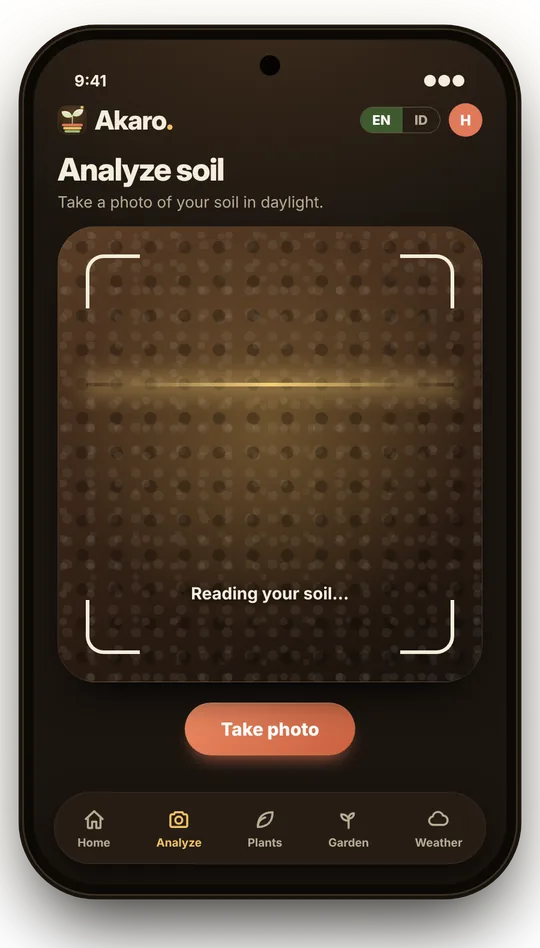
01Point your phone at a handful of earth. Akaro scans it and gets to work.
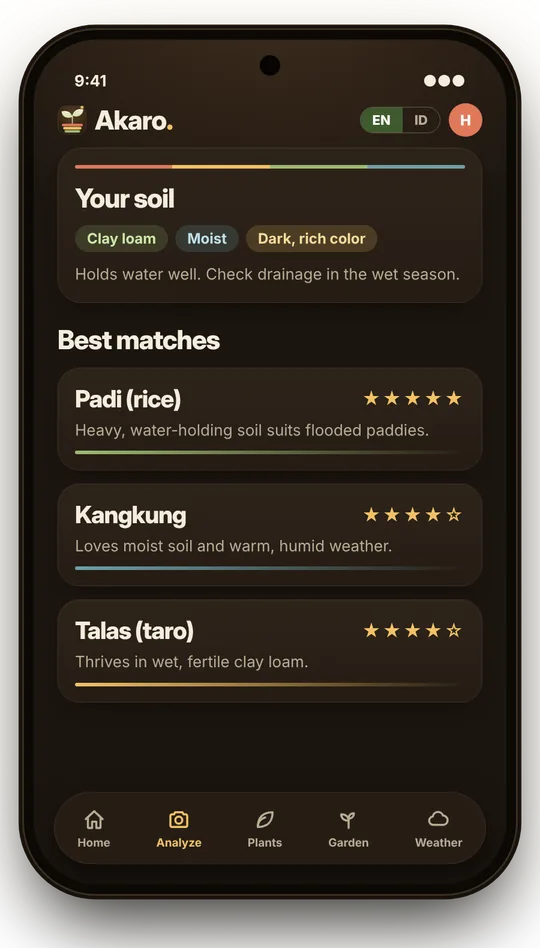
02Texture, moisture and color, then plants ranked for your soil, each with a reason.
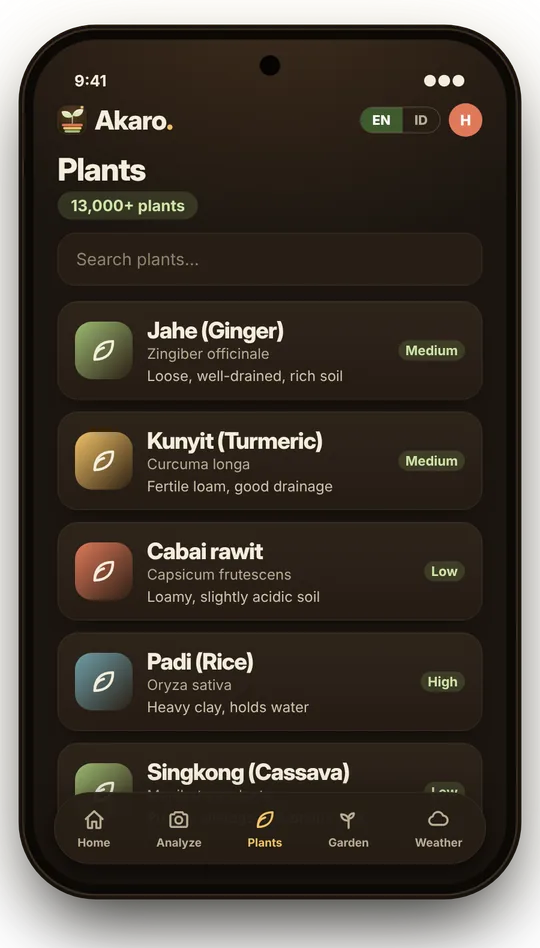
03Search more than 13,000 plants with their soil, climate and water needs.
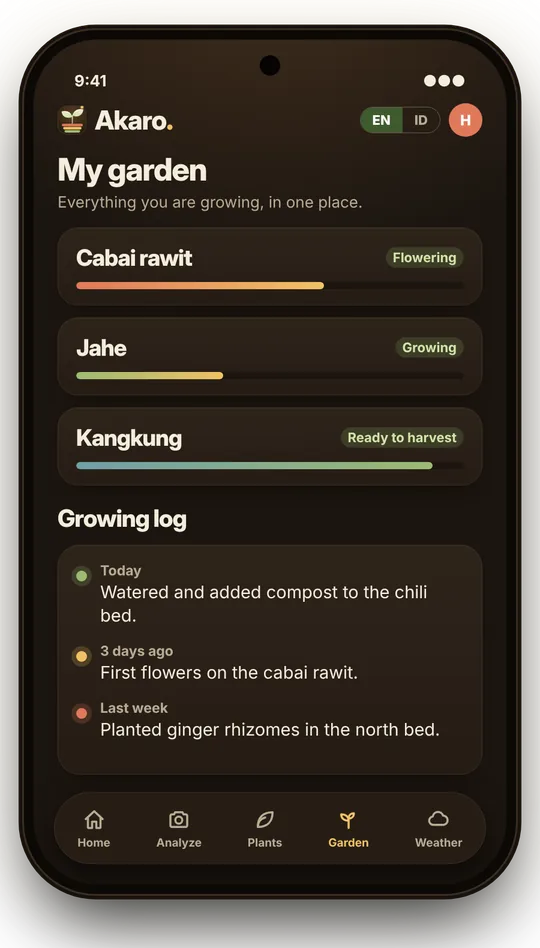
04Track what you plant and note what you do, so next season starts with notes, not memory.
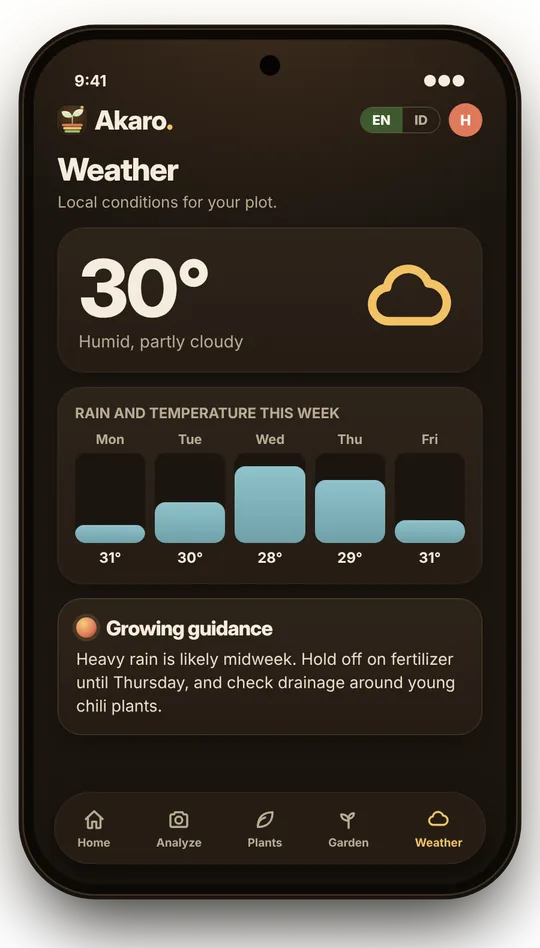
05A local forecast turned into plain advice for your plot.
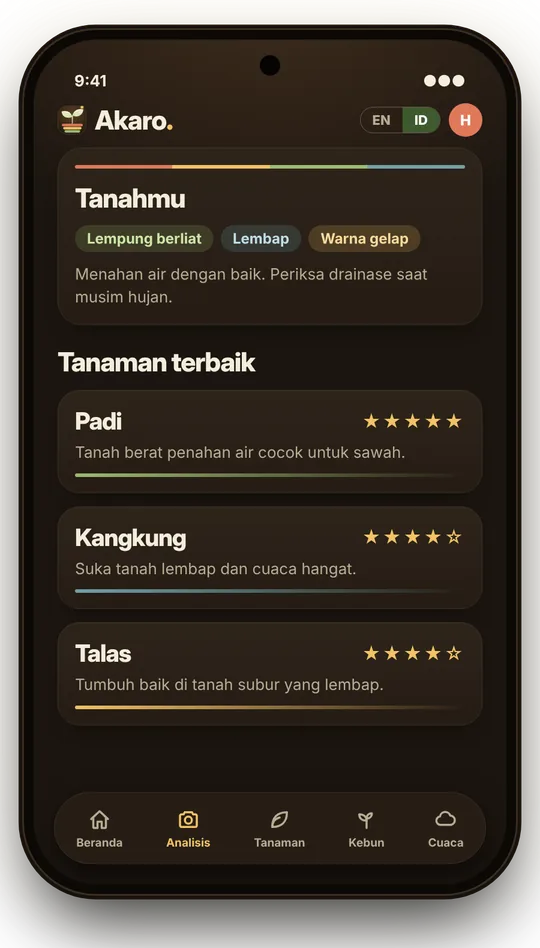
06Switch between English and Bahasa Indonesia with one tap.
Screens show sample data.
Built for a phone in a field: quick, clear, and in your language.
Akaro looks at color and texture, then estimates pH, organic matter and nutrient levels, with a plain-language fix for each.
Search the library or let Akaro shortlist what fits.
Forecast-aware tips, like holding water before heavy rain.
Keep notes and photos for every plot, season after season.
Switch any time, everywhere in the app.
Gemini reads the photo and Groq's fast models help match plants, so answers come back quickly.
Open it like any other app, and a friendly offline page keeps it from breaking when the signal drops.
Same seed, same twelve weeks. One plot is guessed at. The other follows Akaro's advice.
Illustrative growth to show the idea, not measured data.
Testing soil in a lab is the gold standard, but for most small farms it means digging samples, getting them to a lab, paying, and waiting. Akaro gives a free first look in the field.
Akaro turns a messy photo into clean, comparable data, joins it with other datasets, and ranks what to plant.
Under the hood
plants in the Akaro plant library today
Including 1,100+ researched with full soil, climate and water details, and growing every day
Growing every day. Progress shown on a log scale.
A vision AI model reads each soil photo and returns the same fixed fields every time, so every analysis can be compared and tracked.
{ "soil_color", "texture",
"estimated_ph_range",
"organic_matter", "drainage",
"fertility_notes",
"natural_remedies": [ ... ],
"confidence_note" }Assembled from public plant datasets such as GBIF and USDA plus researched entries, stored in two languages, and extended automatically when someone searches for a species it doesn't have yet.
The soil report and the farmer's location are scored against the plants in the library that have full growing details. The six best crops come back, each with a one-line reason.
A five-day forecast from Open-Meteo is joined in and turned into plain-language guidance for your garden.
Row Level Security in the database means each person can only read and write their own analyses, garden and growth log. The AI key never reaches the browser.
English and Bahasa Indonesia live side by side in the same records, so advice reads naturally in both.
Unstructured pixels
Color, texture, pH, organic matter, drainage
Crop dataset and weather forecast
Rank every crop by fit
A plain-language plan
Drag the sliders. Every crop is re-scored instantly with a simplified, illustrative scoring model, and the math is shown below.
Each cell shows the best crop for that pH and drainage, at your organic matter level. Brighter means a better fit. The white ring is your soil.
fit = 0.5 x pH match + 0.3 x drainage match + 0.2 x organic matter match
A simplified, illustrative model with example crop needs. Amber names are native Indonesian plants. The app compares the photo report with its full crop database.
Each bar is a crop's preferred pH range, placed at its preferred organic matter. The closer your soil lands to a bar, the brighter it glows. Amber bars are native plants.
Every analysis returns the same fields, so soils can be compared and tracked over time.
Soil readings, crop data and live weather work together instead of sitting apart.
A plant that isn't in the database gets researched and saved, so real use makes the data richer.
Most plant tools stop at the crops everyone already grows. Akaro also focuses on Indonesia's indigenous and traditional plants, the ones adapted to local soil and rainfall, so they get a place in the data too.
Native to the Banda Islands in Maluku, and a spice that shaped world history.
Native to the Maluku islands, where clove trees grew long before they were traded.
A staple of Papua and Maluku that thrives in wet, swampy soil where other crops struggle.
A palm fruit native to Java and Sumatra, with scales like a snake's skin.
A rhizome from Java, used for generations in traditional jamu.
A fruit tree of the Malay archipelago, loved across the region.
Every plant in Akaro carries its Indonesian name, and we're growing the database to include many more native species, so recommendations reflect what actually belongs in this soil and climate.
What exists today, straight from the app as it stands.